How to develop a social technology for older adults in China to help them with MOBILITY and ADLs?
Harvard Move Lab- Supported by the Jiangsu Industrial Technology Research Institute in Nanjing
My role: Lead User Researcher
Date: April 2021- Jul 2022
-
Research method:
I interviewed 33 users — 18 caregivers, 10 older adults, and 5 stakeholders. The interviews were conducted remotely via WeChat in Chinese, with the help of a translator.
I also organized a workshop and invited 9 experts with different backgrounds including gerontology, biomechanics, rehabilitation, economics, demography, technology, and others.
The workshop included 2 activities:Brainstorm and categorize the biggest challenges to healthy aging in China,
Discuss the root causes and effects of selected challenges
Moreover, I reviewed more than 40 articles about aging, fear of falling, technologies for older adults, gamification in rehabilitation, and frailty evaluation.
We collaborated with Hefei University of Technology, Aging department of Jiangsu Industrial Technology Research Institute (JITRI), and Minzu University of China.
Research findings:
We focused on five key areas of aging in China:
1. Exercise & Rehabilitation: “Before taking care of my husband, I used to play basketball… but after his death, I no longer play. I feel my body isn’t strong anymore.”
2. Fear of Falling: “After I broke my leg, my son accompanied me on walks. I was afraid I couldn’t stand firmly. He held my waist so I could move slowly.”
3. Climbing Stairs: In Shanghai, over 220,000 residential buildings with six or more floors have no elevators, and 70% of their residents are older adults.
4. Moving Disabled Elders: About 8% of adults over 80 in China cannot use the restroom independently.
5. Cleaning Disabled Elders: “He didn’t want anyone — not even his son — to help him with bathroom tasks.”
-
Ideation:
We started with brainstorming different ideas in each section and rated them based on their feasibility, desirability, and viability.
<img src="https://images.squarespace-cdn.com/content/6849df8a3dabe50908c16035/91d193e3-8e72-436b-8fb2-2d4f1fdd16ad/Image.png?">
Future project 1:
This is the storyboard for one of the concepts to help caregivers with moving older adults.
<img src="https://images.squarespace-cdn.com/content/6849df8a3dabe50908c16035/c1e2d4e9-f70d-4c4f-9472-61de77e50d0f/Image+2.png?">
Future project 2:
Muscle Health Evaluation: A system combining a wearable sensor worn on the shank, a mobile app for elderly, and a web platform for therapists to assess muscle health and provide personalized exercise recommendations.
<img src="https://images.squarespace-cdn.com/content/6849df8a3dabe50908c16035/61a13ece-3475-4f53-ab18-88a62f92bb28/Image+3.png?">
Future project 3:
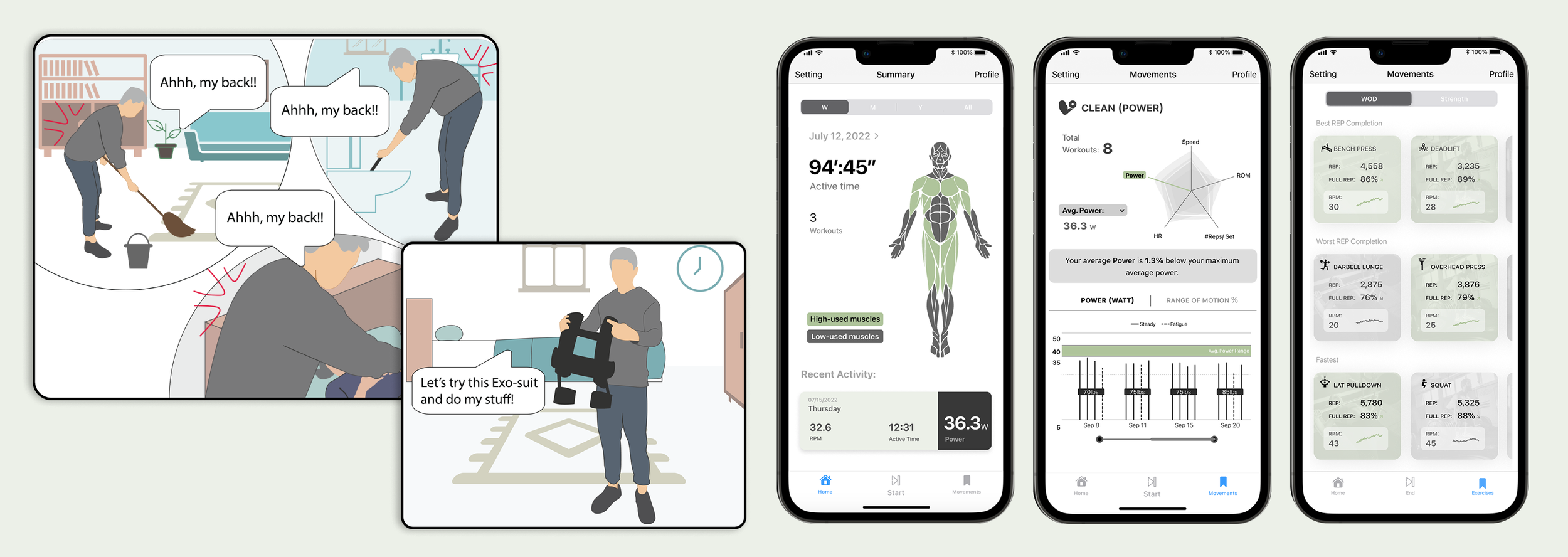
Strength Training App: A connected system that includes two wearable sensors — one worn on the wrist and one on the chest — along with a mobile app designed for older adults and a web platform for therapists to monitor progress and adjust training plans.
<img src="https://images.squarespace-cdn.com/content/6849df8a3dabe50908c16035/6781f772-276d-4e5c-ba92-b5cb6aa4a979/Elderly+-+14.png?">
-
A PhD student from the first Future project developed a wearable device to assist caregivers in safely moving elderly individuals.
A startup emerged from the third Future project, creating sensor technology to detect and track exercise movements.